



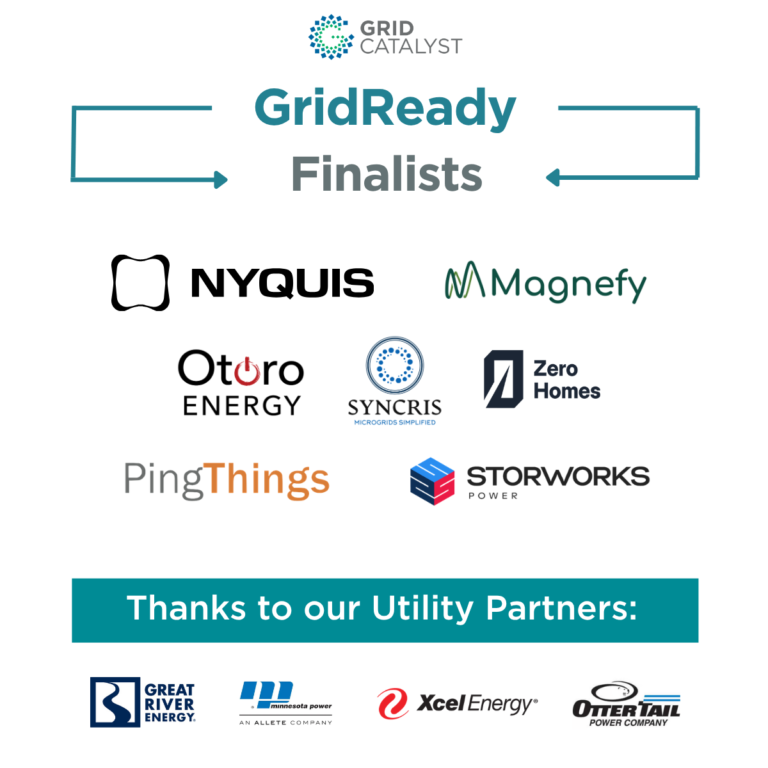
Seven of the nation’s most promising energy technology companies have been selected as finalists for GridReady, Grid Catalyst’s inaugural utility innovation partnership with Great River Energy, Minnesota Power, Xcel Energy, and Otter Tail Power. The finalists will pitch this week to Minnesota’s leading utility and industry partners, vying for an opportunity to pilot their technology and prove its impact and market readiness.
A New Model for Utility Innovation
When GridReady launched earlier this year, it was designed to solve a problem the energy industry knows well: utilities need proven, reliable technology, but the best new technology rarely comes with a utility-scale track record attached. This creates a fundamental gap between the technologies we need to transform the grid and the adoption pathways required to do so.
GridReady exists to close that gap. The program gives Minnesota’s utilities an additional pathway to advance the state’s most pressing energy priorities: keeping the grid reliable and affordable, strengthening resilience against extreme weather and growing load demand, and accelerating progress toward Minnesota’s goal of 100% clean energy by 2040. The inaugural cycle focused on three target areas represented in the finalist slate: grid modernization and grid-enhancing technologies, energy storage, and electrification.
Meet the GridReady Finalists
The selected finalists reflect the full breadth of GridReady’s focus areas: grid modernization and grid-enhancing technologies, electrification, and energy storage:
Magnefy is developing an end-to-end transformer predictive monitoring platform that combines non-invasive hybrid DC–80 MHz magnetic sensing with multimodal, sensor-agnostic AI to catch developing electrical anomalies, from harmonics and partial discharge to arcing, months before failure. By fusing high-frequency electrical signatures with operational and maintenance data, Magnefy delivers fleet-wide risk prioritization and actionable maintenance recommendations at a fraction of the cost of conventional monitoring, helping utilities extend transformer life and reduce unplanned outages.
Nyquis is a grid intelligence platform that gives utilities a real-time view of the grid using just two sensors per feeder. Nyquis reveals what existing systems miss, faults forming before outages or wildfires, unused capacity, and places where new loads can connect, and turns that data into a continuously updated model of what’s happening on the grid and where to act. The result: fewer failures, better use of existing infrastructure, and faster interconnection for data centers and other large loads.
Otoro Energy builds long-duration flow batteries around a new electrolyte containing iron, chromium, and organic molecules dissolved in water at neutral pH -non-flammable, non-toxic, and free of any thermal runaway mechanism. Duration is modular: to add hours of storage, operators simply add electrolyte fluid. Otoro’s 10-hour system runs at 90% round-trip efficiency and has demonstrated zero degradation over 700 independently tested cycles, offering utilities a safer, domestically manufactured, PFAS-free alternative to conventional battery chemistries.
Ping Things built PredictiveGrid, a platform that preserves utilities’ operational measurements at full fidelity and combines them with asset, weather, and contextual data at massive scale. That continuous record enables event reconstruction, wide-area analysis, and a full understanding of what grid assets have experienced across their lifecycles, turning data utilities already collect into analysis, ready evidence for advanced analytics and physical AI. Already proven in production utility environments, PredictiveGrid helps utilities understand today’s grid while preparing for tomorrow’s questions.
Storworks developed FlexJoule, a thermal energy storage system that stores heat in modular, high-temperature concrete blocks. FlexJoule unlocks untapped capacity within existing interconnections or process heat systems, delivering steam, electricity, or both on demand, and charging from steam or electricity when it’s not needed. Manufactured using unconstrained supply chains with no critical minerals, cycling degradation, or thermal runaway risk, FlexJoule delivers speed-to-capacity at a fraction of the cost of lithium-ion storage.
Syncris is developing modular, scalable energy storage and grid-forming power conversion systems for utility and critical infrastructure applications. Syncris’s platform allows energy storage assets, renewable generation, and conventional power resources to operate together as resilient, intelligent energy systems, strengthening grid reliability and supporting critical operations when power continuity matters most. Designed as a flexible platform rather than a single-use product, Syncris helps utilities adapt their infrastructure as grid requirements evolve.
Zero Homes is rebuilding the residential electrification process as a technology-first “Cloud Contractor.” Homeowners complete a virtual, smartphone-based assessment that builds a digital twin of their property, which Zero Homes’ engine turns into a precise, DOE-validated energy assessment. The platform then manages equipment procurement, incentive stacking, and a network of pre-negotiated, vetted contractors, eliminating costly in-home sales visits, reducing total project costs by up to 20%, and maintaining a homeowner Net Promoter Score above 80.
Why the Pilot Model Matters
GridReady builds on a track record Grid Catalyst has built since 2021, helping mobilize 16 cutting-edge technology pilots across Minnesota, from a novel thermal energy storage installation at the University of Minnesota Morris to a first-of-its-kind CO2 heat pump in a Saint Paul training facility.
That track record reflects a lesson Grid Catalyst has learned directly: the best technology does not always make it to the marketplace. Promising startups often fail because they cannot access real-world operations to pilot, deploy, and scale. And industry and utility adopters have a difficult time saying yes to a pilot without additional technical or market traction to de-risk the opportunity. No matter how strong the technology is. That is the commercialization “valley of death” that has quietly killed off game-changing energy technologies before they ever reached the market.
High-profile, well-structured pilots are critical to advancing the technologies we need for our future grid. They give utilities the real-world performance data they need to move from cautious observer to confident adopter, and they give startups the validated deployment history that unlocks their next stage of growth. That is exactly the role GridReady is designed to play, matching validated, utility-ready technology with the partners, sites, and structured process needed to prove it at scale.
Minnesota: A Living Lab for the Energy Transition
This finalist cohort is the latest proof point of something bigger happening in Minnesota: the state is becoming a living lab for the energy transition. Meeting Minnesota’s clean energy goals requires more than policy. It requires real-world deployment of cutting-edge technologies to prove reliability, affordability, and resilience to enable deploying them at scale. Minnesota’s utilities have already shown they’re willing to do that work, adapting quickly to meet growing system and customer demands while building more diversified, flexible generation.
Through partnerships like GridReady, that willingness becomes infrastructure. Every pilot run through the program adds to a growing body of evidence that new grid technology can work here first. Each new cohort of innovative companies and technologies doesn’t just bring individual technologies forward; it reinforces Minnesota’s reputation as the place where the energy transition gets tested, proven, and built.
What Is Next
This week, the finalists will pitch to the GridReady utilities, Great River Energy, Minnesota Power, Otter Tail Power, and Xcel Energy, to show the industry they are ready to pilot, scale, and make an impact.
GridReady is made possible through the Minnesota Energy Alley initiative, a partnership between the Minnesota Department of Commerce, Clean Energy Economy Minnesota, and Grid Catalyst, with additional support from the Wells Fargo Innovation Incubator (IN2) and Evergreen Climate Innovations.
Congratulations to all seven finalists. Minnesota’s utilities have made it clear that the energy transition gets built here, and we are proud to give you the opportunity to show them what is possible.
#
Additional resources to learn more about GridReady and the importance of pilots and utility innovation.
- Volts Podcast Episode – Why Utility Innovation is a Big Challenge (Grid Catalyst LinkedIn article introducing the podcast and relevance to the GridReady program)
- 2025 Utility Innovation Study, co-authored by Grid Catalyst and the University of Minnesota (Gabe Chan and Matt Grimley of the Humphrey School of Public Affairs)
- GridReady Program Announcement
- Grid Catalyst blog – Why Energy Innovation Pilots Matter
- Minnesota is Becoming a Living Lab State. Then What? (article in Twin Cities Business, by Charlie Rybak)